
ADVICE · JUNE 11, 2026 · BY DAVID MELNYCHUK
The Best Deck Stain for Pennsylvania Weather: What Survives and What Peels
Pennsylvania is close to a worst-case test lab for deck finishes. We get real winters, humid summers, and a spring where the boards freeze at 6 a.m. and bake by 2 p.m. A stain that holds up fine in Arizona peels here in 18 months. After refinishing decks and porches across Lancaster and Chester County for years, we have earned some strong opinions about what belongs on wood in this climate.
The short version: penetrating oil stains beat film-forming products here, semi-transparent beats solid for most horizontal surfaces, and preparation matters more than anything printed on the can. The long version follows, including the honest part about how often you will be doing this again.
Why Pennsylvania weather is hard on deck stain
Three forces work on a Lancaster County deck at the same time. The first is freeze-thaw. Water gets into the wood, freezes, expands about 9 percent, and pushes the finish off from underneath. South central Pennsylvania crosses the freezing line dozens of times every winter, so this is not one event. It is a season-long pry bar working every board.
The second is humidity. July and August around here routinely sit above 70 percent relative humidity. Wood swells in summer and shrinks in winter, sometimes an eighth of an inch across a single 6 inch board. Any finish riding on top has to stretch and shrink with it. Rigid coatings crack. Cracks let water in. Water starts the freeze-thaw cycle under the film, and now the failure is invisible until a whole sheet lets go.
The third is sun. UV light breaks down lignin, the natural glue holding wood fibers together. That silver-gray color on an old deck is a layer of dead surface fiber. Stain applied over gray fiber bonds to the dead layer, not to sound wood, and it leaves when the dead layer does. Penn State's Pennsylvania Housing Research Center publishes good material on how our specific climate loads work on residential construction, and decks catch all of it with zero protection.
Whatever product you choose has to survive all three forces at once. Most cans on the shelf were formulated to survive a marketing meeting.
Penetrating oil vs film-forming stains: why films peel here
A penetrating oil stain soaks into the wood fiber and cures inside it. There is no layer sitting on top, so there is nothing to peel. When it wears, it fades gradually and evenly. Maintenance is a wash and a recoat, no stripping. Products in this family include Armstrong Clark, TWP, and the oil-based Cabot lines. This is what we use on nearly every exterior wood job.
A film-forming product dries as a thin plastic layer on top of the board. Most water-based acrylic stains, all deck paints, and every thick rubberized restore coating fall in this group. On vertical siding, a film works fine because water runs off. On a horizontal deck board in Pennsylvania, a film is a promise to peel. Snow sits on it for weeks, water finds an edge, freeze-thaw pries, and by year two you have flakes. At that point you cannot simply recoat. You have to strip or sand the failure off first, and stripping a failed film from 300 square feet of decking is slow, chemical, miserable work that often costs more than the original stain job.
The thick restore-style coatings deserve a special warning. They are marketed as the rescue for worn decks, and they are the single most common failure we get called to undo. When they let go, they hold moisture against the wood underneath and rot it. If your boards are worn enough that a coating this thick sounds attractive, the honest answer is usually board replacement, not thicker paint. We walk through that decision in deck refinishing vs replacement.
Semi-transparent vs solid stain: the real tradeoff
Semi-transparent stain is our default recommendation for walking surfaces. It shows the grain, penetrates the fiber, and fades instead of peeling. When it looks tired, you clean the deck and put on another coat in an afternoon. The tradeoff is a shorter cycle, roughly 2 to 3 years on horizontal boards, and less pigment means less UV protection.
Solid stain carries more pigment, so it blocks UV better and hides mismatched or patched boards, which matters on an older deck with five generations of repairs. On verticals like railings and skirting it can run 4 to 5 years. The tradeoff is serious: solid stain builds a film as coats stack up, and on horizontals that film eventually peels like paint. It also locks you in. Once a deck is solid-stained, it stays solid-stained unless you pay for a full strip or sand.
Our rule of thumb for Pennsylvania: semi-transparent on deck boards and stair treads, solid acceptable on railings and vertical trim, and if the deck already wears solid stain, stay in that lane or budget real money to escape it.
Prep is 70 percent of the result
Stain fails from below far more often than it fails from above. The product gets the blame, but the prep took the shortcut. Here is what correct prep looks like on our porch and deck refinishing jobs, and none of it is optional.
A $35 stain over correct prep will outlast a $70 stain over dirty, glazed, damp wood every single time. When a stain job fails in one year, we almost never find a bad product. We find skipped prep.
- Clean with a sodium percarbonate deck cleaner and a stiff brush, then rinse below 1,500 psi with a fan tip. Higher pressure furs the surface fiber and tears up soft spring grain.
- Brighten with oxalic acid. It neutralizes the cleaner, pulls out tannin and rust staining, and opens the grain so oil can penetrate.
- Sand the horizontals with 60 to 80 grit to cut off dead gray fiber. Never go finer than 80 outdoors. Finer grits polish the surface and close the pores, and the stain sits on top instead of soaking in.
- Check moisture. Wood needs to read below 15 percent on a moisture meter before stain goes on. After a rain, that typically means two full dry days in summer, longer in spring.
- Replace, do not disguise. Any board that is cupped, punky, or cracked through gets swapped before finish, because stain is not a structural product.
The application window: when to stain in Pennsylvania
Oil stain wants surface temperatures between 50 and 90 degrees, no rain for roughly 24 to 48 hours after application, and dry wood going in. The ideal day is overcast, 60s or low 70s, with low humidity. Hot direct sun flashes the stain before it can penetrate, which leaves lap marks and a sticky surface that never fully cures.
Dew is the quiet killer. A perfect afternoon application can be ruined by condensation settling on uncured stain at 9 p.m. Check the dew point spread, and stop staining by mid afternoon so the surface can set before evening moisture arrives.
In practice, the reliable Pennsylvania windows are mid May through late June and September through mid October. Spring before that is too wet, deep summer flashes the oil and afternoon storms ambush you, and after mid October the nights get too cold for a proper cure. That forecast lines up maybe a few dozen usable days a year, which is why our stain calendar is mostly full by April.
The honest maintenance cycle nobody prints on the can
Here is the truth the label avoids: no stain survives 10 years on a horizontal deck surface in this climate. Not one. The labels claiming long life are measuring vertical surfaces, often in milder climates. On a Pennsylvania deck floor, plan on recoating semi-transparent oil every 2 to 3 years and refreshing solid verticals every 4 to 5. Shade, tree cover, and a north face stretch those numbers. Full southern sun shortens them.
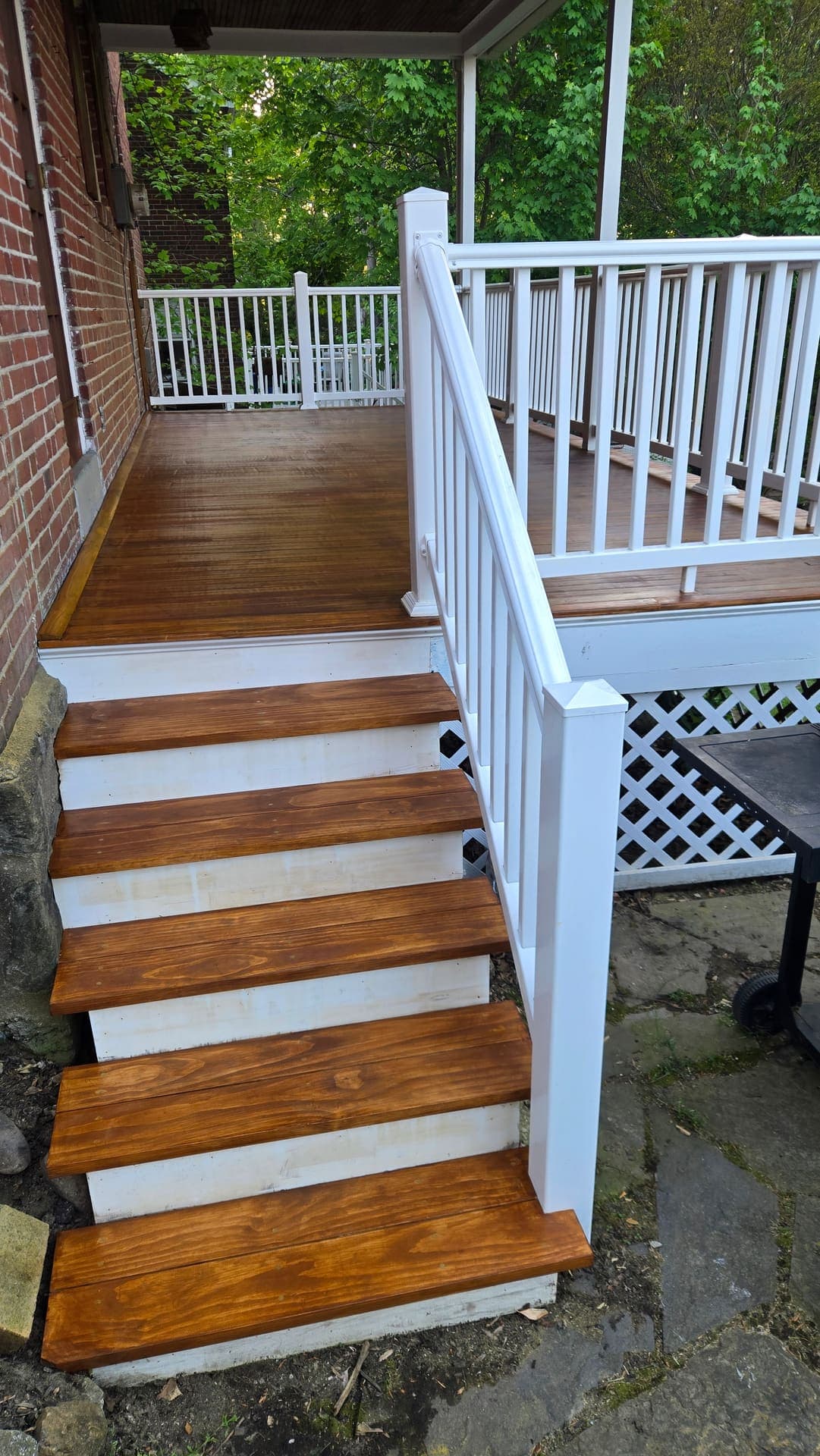
The good news is that a maintained cycle is cheap and fast, because a clean and recoat needs no stripping. Neglect is what gets expensive. Around here, a full professional sand and stain on a typical porch or deck runs about $1,000 to $2,700 depending on size and condition. Our jobs typically land closer to $900 to $2,500, because one in-house crew handles prep, repairs, and finish without waiting on anyone between steps. You can see the level of result on a porch refinishing project we completed in Lancaster.
When staining is the wrong move, and when you should not hire us
If your boards are cupped, spongy at the fasteners, or cracked through, stain is cosmetics on a structural problem. It will look good for one season and then you have spent stain money on a deck that still needs boards. The honest sequence is repair or resurface first, finish second. Our deck refinishing vs replacement guide covers where that line sits.
And if your deck is a small 6 by 8 landing and you are reasonably handy, do it yourself. A gallon of quality oil stain runs $40 to $70, a cleaner and brightener kit about $30, and the whole job is one careful weekend. Paying a contractor mobilization money for a job that size does not serve you, and we would rather tell you that than quote it. Where we earn our keep is the big stuff: wraparound porches, two-story decks, spindle railings that eat hours, and decks that need board surgery before the finish goes on. For those, call us at (717) 210-8194.
Questions we hear a lot
What is the best month to stain a deck in Pennsylvania?
Late May through June, or September through mid October. You need surface temps of 50 to 90 degrees, wood moisture below 15 percent, and no rain for about 48 hours after. Early spring wood is too wet, and July sun flashes oil stains before they penetrate.
How long does deck stain last in Pennsylvania?
On horizontal boards, 2 to 3 years for semi-transparent oil. Verticals go 4 to 5 years. Any product promising 10 years on a PA deck floor is quoting a test that does not resemble your deck.
Can I stain over old deck stain?
Over a faded semi-transparent of the same base, yes: clean, brighten, dry, recoat. Over solid stain or any peeling film, no. New stain cannot penetrate a film, so it bonds to the failure and peels with it. Those decks need stripping or sanding first.