
PRICING · JULY 2, 2026 · BY DAVID MELNYCHUK
Composite vs Wood Deck Cost: The Real 10 Year Math for PA Homeowners
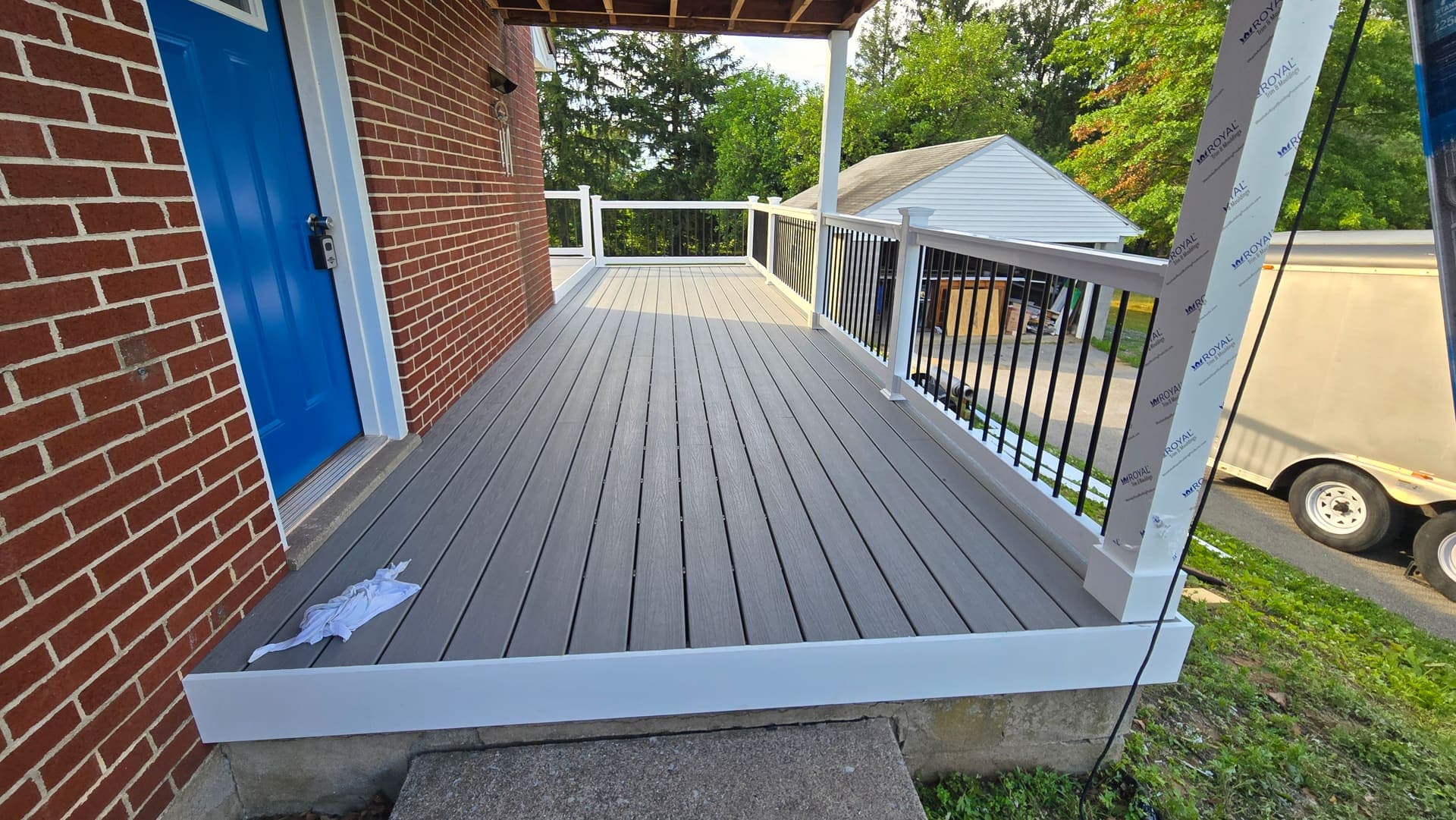
Every composite vs wood conversation starts with the same sticker shock: composite costs roughly half again as much on day one. And every glossy composite brochure answers with the same promise: you will make it back on maintenance. One of those statements is a fact and the other is marketing, so we ran the actual 10 year numbers for a typical Pennsylvania deck, using the real prices we charge and the real maintenance cycles this climate enforces.
Short version: the brochure is more right than wrong, but the crossover takes most of a decade, and there are four situations where wood is still flatly the better buy. Here is the math.
The build cost gap today
Around here, pressure-treated wood decks quote at roughly $42 to $65 per square foot installed, and composite runs about $65 to $100. Our jobs typically land at $40 to $60 for wood and $60 to $95 for composite, usually in the lower half of those bands, because one in-house crew frames, decks, and rails the project without paying three subcontractors to wait on each other.
Put that on a typical 16 by 20 foot deck, 320 square feet. Wood lands around $13,000 to $19,000. Composite lands around $19,000 to $30,000. Call the day-one gap $6,000 to $11,000 for the same footprint. That is real money, and it is also the last day wood is ahead in this comparison. The next ten years all run in one direction.
What a wood deck costs you after the build
Pennsylvania weather does not let wood rest. Freeze-thaw, humid summers, and UV mean a finish cycle that never ends, plus the occasional board that gives up early. Here is the honest decade for a 320 square foot wood deck.
Add it up and a professionally maintained wood deck costs roughly $3,600 to $8,500 over ten years beyond the build. The DIY version costs $700 to $1,200 in materials and roughly 8 to 12 full weekends of your life.
- Stain cycle every 2 to 3 years. A professional clean, sand, and stain runs $900 to $2,500 on our jobs. Expect 3 to 4 cycles in a decade. DIY costs about $150 to $250 in materials per cycle plus 20 to 30 hours of labor you provide.
- Board and rail repairs, years 6 to 10. A few cupped or split boards, a wobbly rail section, popped fasteners: budget $300 to $800 once or twice in the back half of the decade.
- Annual wash. An hour or two with a cleaner and a hose, or folded into the stain cycle. Cheap, but it is not optional if you want the stain intervals above.
- The skipped-maintenance tax. Skip two cycles and the price of catching up doubles, because failed finish means stripping, and gray boards mean heavy sanding. Neglected wood decks age on dog years.
What a composite deck costs after the build
The composite decade is short enough to write in one paragraph. You wash it with soap, water, and a soft brush a couple of times a year, per the manufacturer's own care instructions from Trex. No stain, no sanding, no sealing, ever. Budget maybe $0 to $500 over ten years for cleaning supplies and the odd scratched board swap. Modern boards carry 25 to 50 year fade and stain warranties.
Honesty section: composite is low maintenance, not no maintenance, and not indestructible. It scratches under dragged furniture, it fades slightly and permanently over the first season, dark colors get genuinely hot in full July sun, and mold will grow on a dirty north-facing surface if you never wash it. It is also plastic and wood flour, not lumber: it needs correct joist spacing, usually 16 inches or less, and good under-deck airflow, or it will sag and hold moisture. A composite deck built on a bad frame is an expensive way to have wood problems anyway.
One note on the wide $60 to $95 spread: composite is not one product. Entry-level boards are capped on three sides with a simpler grain and sit at the bottom of the range. Mid-tier boards add better fade resistance and more convincing texture. Premium lines cap all four sides and mimic hardwood well enough to fool people at porch distance. The 10 year maintenance math below works for all of them, because the cap is what does the low-maintenance work and even entry boards have one. If the budget is tight, a mid-tier board on a well-built frame beats a premium board on a cheap one every time.
The crossover year
Now the math. Take the same 320 square foot deck at our typical mid-range numbers: wood built at $16,000, composite at $24,000, an $8,000 gap. Professional wood maintenance averages about $600 to $850 per year across the decade. Composite maintenance averages about $50.
At those rates, composite claws back $550 to $800 a year, which closes an $8,000 gap in roughly 10 to 14 years with professional maintenance. By year 10 the totals sit near $22,000 to $24,500 for wood and $24,500 for composite: effectively a tie, with composite pulling ahead every year after. If you DIY the staining, the money crossover honestly may never come, because your labor is free on paper. Your weekends are the currency that actually pays the difference, which brings us to the next section.
One more factor tilts the long game: at year 10 a maintained composite deck looks close to new, while a year 10 wood deck looks like a 10 year old wood deck between stain cycles. If a home sale sits anywhere in your decade, that difference shows up at the listing photos.
The cost nobody puts in the spreadsheet: your time
A DIY stain cycle on 320 square feet is not a Saturday. It is a wash day, a dry day or two you do not control, a sanding session, and a careful application day, call it 20 to 30 hours per cycle including the railing spindles that eat half the time. Times three or four cycles a decade, you are looking at 80 to 120 hours of deck maintenance, performed in the exact summer weeks you built the deck to enjoy.
Some people genuinely like that work, the same way some people like mowing. No judgment, wood is a fine choice for them. But price your own hours at anything above zero and the comparison shifts hard. Wood is cheaper until the third time you spend a holiday weekend on your knees with a stain pad.
When wood still wins, honestly
We install more composite than wood now, but we still build wood decks on purpose, and we will tell you when wood is your right answer rather than upsell you into a bigger ticket. Four situations where it clearly is:
There is also a middle path worth knowing: if you have a structurally sound wood deck with tired boards, resurfacing with composite on the existing frame captures most of the low-maintenance benefit for $25 to $45 per square foot instead of full new-build money. We cover that decision in deck refinishing vs replacement.
- The budget is the budget. A $13,000 wood deck you build this summer beats a $24,000 composite deck you wait three years for. The best deck is the one your family actually uses.
- Rental or short-hold property. You will not own the maintenance decade, so paying up front for savings that mature in year 10 helps the next owner, not you.
- Selling within 3 to 5 years. Same math: a fresh wood deck shows beautifully at listing time and you exit before the stain cycles stack up.
- A deeply shaded lot. UV drives most finish failure. A deck under mature shade holds stain noticeably longer, which stretches the cycles and weakens the composite payback case.
If you go composite, build it like it matters
The boards get the brochure, but the frame does the work, and the frame is still pressure-treated wood. A composite deck is only as good as its footings, ledger, and joists. We build the frame to the same standard either way: footings below frost at 36 inches, a flashed and bolted ledger, joist protection tape on the frame tops so the wood outlasts the 25 year boards sitting on it, and hidden fasteners so the surface stays clean.
Composite has one more quiet advantage in Pennsylvania: it installs fine in cold weather, when stain and paint cannot. We built a composite deck in Elizabethtown in the middle of winter, which meant the homeowners started spring with a finished deck instead of a contractor waiting list. If you want the real number for your yard instead of a per-square-foot abstraction, our deck building quotes are itemized and free: (717) 210-8194.
Questions we hear a lot
Is composite decking worth the extra cost?
If you plan to stay in the home 7 to 10 years or more, usually yes: maintenance savings close the price gap around the decade mark and it is all savings after. Selling within 3 to 5 years or working with a tight budget, wood is the better buy.
Is composite decking really maintenance free?
No, it is low maintenance. It needs washing a couple of times a year, it can scratch, and dark boards get hot in full sun. What it never needs is sanding, staining, or sealing, and that is where the money and weekends are.
How long does each type of deck last?
A maintained wood deck runs 15 to 25 years in Pennsylvania. Composite boards carry 25 to 50 year warranties, but they sit on a pressure-treated frame, so the frame becomes the clock. That is why we tape the joists and flash the ledger carefully on composite builds.