
ADVICE · JULY 9, 2026 · BY DAVID MELNYCHUK
Crumbling Concrete Steps Repair: What Works, What Fails, and What It Costs
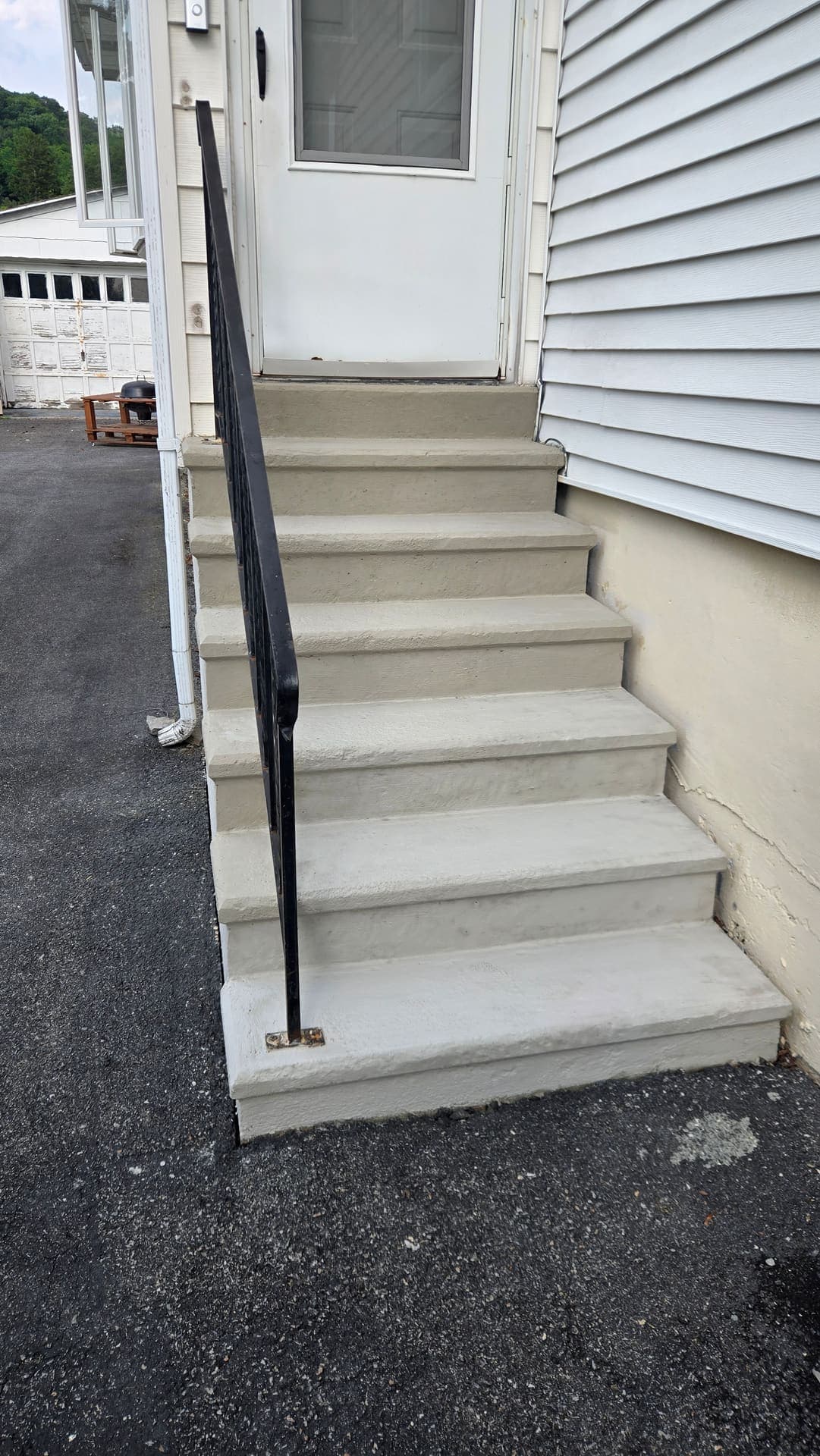
Every spring in Pennsylvania, front steps shed another layer of gray gravel onto the walk, and every spring homeowners sweep it up and hope. Crumbling steps are not just ugly. They are the most used walking surface on the property, they get worse every winter without exception, and past a certain point the cheap fix stops being available.
Here is the straight story on why steps fail here, how to test how bad yours really are, what resurfacing costs and involves, where the big-box patch kits genuinely work, and when the honest answer is a full tear-out.
Why concrete steps crumble in Pennsylvania
The flaking you see is called spalling: the top layer of cement paste letting go of the concrete underneath. In our climate it has three causes, usually working together.
Freeze-thaw plus salt. Concrete is porous. Water soaks into the surface, freezes, and expands about 9 percent, breaking the paste apart from inside. Rock salt makes this dramatically worse, and not mainly by chemistry: salt keeps water liquid at lower temperatures and pulls more moisture into the surface, so the concrete goes through more freeze cycles at higher saturation. Salted steps age several winters per winter.
Bad finishing on day one. A lot of residential steps were doomed at the pour. Troweling bleed water back into the surface weakens the top paste layer. Finishing too early seals water just below the surface. Hand-mixed bag concrete without air entrainment, the microscopic bubbles that give freezing water somewhere to expand, has poor freeze-thaw resistance from birth. If your steps started pitting within a few years while the sidewalk beside them stayed fine, this is usually the reason.
Never sealed. Concrete left unsealed drinks water freely. A $40 jug of penetrating sealer every few years prevents most of this story, and almost nobody applies it.
The sound test: find out how bad it really is
Before pricing anything, find out whether the damage is skin deep or structural. The tool is a hammer, or the handle end of a screwdriver. Tap across every tread and riser in a grid and listen. Sound concrete answers with a sharp ring. Delaminated concrete, where a surface layer has separated but not yet fallen off, answers with a dull hollow thud. Mark the hollow zones with chalk. Concrete criticism is a low bar as musical careers go, but your steps will sing you an honest answer.
Then look at the crack pattern. Hairline surface crazing, a shallow web of fine lines, is cosmetic. Cracks that are wide, run through the step, or show offset where one side sits higher than the other are structural. Rust stains bleeding through mean rebar or wire corroding and expanding inside. And probe a spalled spot with the screwdriver tip: if it crumbles deeper and deeper with light pressure instead of stopping at firm material, the failure is not a surface problem.
The verdict matters because every repair option below assumes a sound base. Surface damage plus solid ringing concrete underneath: excellent candidate for resurfacing. Hollow sounds across most of the treads, moving cracks, rust, or crumbling at depth: keep reading to the replacement section.
What resurfacing actually involves
Resurfacing rebuilds the sacrificial surface layer with a polymer-modified cement overlay, a material designed to bond thin and flex slightly, which ordinary concrete cannot do. Done correctly, the new surface bonds stronger than the original paste layer it replaces. Done as a skim of product over dirt and loose material, it peels in a winter, which is why the process matters more than the bucket.
It is a one to two day job for a typical set of steps. You stay off them for 24 to 48 hours, treat them gently the first week, and skip salt entirely the first winter while the overlay finishes gaining strength.
- Remove everything loose. Grind and chip off all delaminated material back to the solid, ringing base. This is the step the cheap job skips.
- Profile and clean. The surface gets roughened for mechanical bond, then washed free of dust. Overlay sticks to texture, not to smooth or dirty concrete.
- Saturate, then bond coat. The base is dampened so it does not suck water out of the overlay, then a bonding slurry is brushed in.
- Overlay and rebuild edges. A 1/4 to 1/2 inch polymer-modified layer goes on, with edge forms to recast crisp square nosings where corners have crumbled away.
- Finish, cure, and seal. A broom finish for traction, proper curing, and a penetrating siloxane sealer to slow the next decade of water absorption.
What resurfacing costs
Around here, concrete step resurfacing quotes typically run about $650 to $2,000 depending on how many steps, how much loose material has to come off, and how much edge rebuilding the nosings need. Our jobs usually land at $600 to $1,800, toward the lower end for a standard three or four step set, because one in-house crew handles demo, overlay, and finish in a single mobilization instead of billing three trips.
For calibration, a full tear-out and repour of a typical step set generally runs $2,000 to $5,000 in our area once demolition, hauling, forms, and the new pour are counted. So resurfacing sound steps saves roughly half to two thirds against replacement, which is exactly why the sound test matters: it tells you whether you are a candidate for the cheaper column. You can see a full before and after on our concrete steps resurfacing project in Coatesville, where pitted, salt-eaten steps came back square-edged and uniform in two days.
The big-box patch kit, honestly
The $15 to $30 tubs of vinyl concrete patcher and quick-setting cement have a legitimate job, and it is smaller than the label suggests. They are good at one chipped corner, one small spall with sound edges, or a broken nosing you rebuild against a scrap-board form. For that repair, buy the tub, follow the directions about dampening the base, and do it yourself on a Saturday. Do not pay anyone $600 to fill one divot, including us.
Where patch kits fail is everywhere else. Feathered thin across a whole spalled tread, they let go at the thin edges within a couple of winters, because thin cement wants to bond to something solid and most of that tread is not. Applied over hollow, delaminated base, they fail immediately in the mechanical sense: you have patched a layer that is itself detaching. And cosmetically they never match, so a five-patch staircase reads as a five-patch staircase from the street. The honest boundary: one or two isolated dings, patch kit. Widespread surface failure, resurfacing. Structural findings, replacement.
When full replacement is the honest answer
Resurfacing over a failing structure wastes your money with our name on it, so we decline those jobs and say why. These findings move you to replacement: cracks that run through the steps or show offset, steps that have settled or tilted away from the porch, rust staining from corroding rebar jacking the concrete apart from inside, hollow sounds across most of the surface, and material that keeps crumbling at depth under a screwdriver tip.
Tilted and settled steps carry an extra urgency that has nothing to do with looks. Once treads slope or riser heights drift unequal, every trip up carries a stumble built into the geometry. Falls on steps are one of the most common serious home injuries, especially for older adults, and the National Institute on Aging's fall prevention guidance puts stairs near the top of the risk list. A crumbling nosing is a cosmetic problem the day before it is the reason someone lands on the sidewalk. If your household includes anyone with mobility concerns, weigh that in the repair-or-replace decision more heavily than the concrete itself.
Replacement is also the moment to fix what the original builder got wrong: proper footing, correct 7 inch risers and 11 inch treads, a landing that drains away from the door, and a code-compliant railing. A railing run adds $500 to $1,500 and is the single best safety upgrade per dollar on any set of steps.
How to make the repair last 15 years instead of 5
The overlay is the reset button, and what you do next decides how long it holds. Skip rock salt permanently: use sand for traction, or calcium magnesium acetate if you need actual melting, and keep the salty slush from the sidewalk from being tracked and shoveled onto the steps. Reapply a penetrating sealer every 2 to 3 years, a 20 minute job with a garden sprayer. And check where your downspout discharges: a gutter dumping water beside the steps keeps the concrete saturated exactly when the freeze arrives, which is how the whole story started.
If your steps are somewhere between gravel pile and fine and you want a straight answer about which column you are in, we do this work regularly through our porch and deck refinishing service, including plenty of projects around Coatesville and the rest of Chester County. The sound test takes us ten minutes, the verdict is free, and we will tell you if the honest answer is a $20 tub of patch and an afternoon of your own time: (717) 210-8194.
Questions we hear a lot
Can badly crumbling concrete steps be repaired without replacement?
Usually, yes. If the base concrete rings solid under a tap test, a polymer-modified overlay rebuilds the surface and edges for $600 to $1,800 on our jobs, versus $2,000 to $5,000 for tear-out and repour. Hollow-sounding, cracked, or settled steps need replacement.
How long does concrete step resurfacing last?
Done over a sound base with proper prep, 10 to 20 years. The variables you control: no rock salt, a penetrating sealer every 2 to 3 years, and keeping roof water from dumping next to the steps.
Why do my concrete steps keep crumbling every winter?
Freeze-thaw cycles plus salt, usually on concrete that was finished poorly or never sealed. Each winter breaks up more surface paste. Patching the crumbs without removing the delaminated layer and sealing the surface just reschedules the same failure for next spring.