
GUIDES · JUNE 4, 2026 · BY DAVID MELNYCHUK
Lead Paint Renovation Rules: What Pre-1978 Homeowners Need to Know
If your house was built before 1978, the law assumes it contains lead paint until testing proves otherwise, and any contractor who disturbs painted surfaces in it has to follow a specific federal rulebook. That rulebook is the EPA's Renovation, Repair and Painting rule, RRP for short, and most homeowners have never heard of it until a contractor either mentions it or, more tellingly, does not.
Since most of the housing we work on in Lancaster and Chester counties predates 1978, RRP is part of our normal workday. Here is the rule in plain words: what it requires, what it looks like on your actual job site, what it adds to the bill, and the one activity, DIY power sanding, that deserves far more fear than the paint itself.
The RRP rule in one plain paragraph
Lead-based house paint was banned for residential use in 1978. The RRP rule, in force since 2010, says that any firm paid to renovate, repair, or paint a pre-1978 home in a way that disturbs painted surfaces must be EPA certified, must use certified renovators trained in lead safe work practices, must contain the work area, must clean up with specific methods, and must give the homeowner the EPA pamphlet explaining all of it before work starts. The full text and the certification lookup live at the EPA lead RRP program page.
The logic behind the rule is worth one sentence, because it explains every requirement that follows: lead paint sitting intact on a wall is a modest hazard, but lead paint turned into dust by sanding, cutting, or demolition is the exposure that actually poisons people, especially children under six. The rule is not about the paint. It is about the dust.
Which projects trigger the rule and which do not
RRP has clear thresholds, and knowing them tells you instantly whether a bidder is playing straight with you:
- Triggered: disturbing more than 6 square feet of painted surface per room for interior work, more than 20 square feet for exterior work, or any window replacement or demolition, regardless of size.
- Not triggered: minor repairs under those thresholds, like a small drywall patch or swapping an outlet cover. Also exempt: homes tested and certified lead-free by a licensed inspector, and housing built 1978 or later.
- Always triggered by windows: worth repeating because it surprises people. Old windows are friction surfaces where paint grinds itself into dust every time the sash moves, which is why the rule treats every window job as significant.
What certified practice looks like on your job site
The rule sounds bureaucratic on paper. On site it is mostly disciplined housekeeping, and you can verify all of it from your kitchen with a cup of coffee. Here is what you should see when a certified firm disturbs old paint: heavy plastic sheeting taped across the work area opening and covering the floor at least six feet out from the disturbance. Signs marking the containment. Workers stepping out of the zone without tracking debris, tack pads at the exit. Surfaces misted with water before scraping or cutting, because wet dust does not fly. A HEPA vacuum, not a shop vac, on every tool that sands or grinds and on the cleanup afterward.
Just as telling is what you should never see: open flame torching of paint, heat guns above 1100 degrees, and power sanding or grinding without HEPA-shrouded tools are flat-out prohibited methods under the rule. A contractor running a belt sander over your 1920s window casings with a dust mask and good intentions is not doing old fashioned honest work. He is aerosolizing lead in your kids' bedroom.
At the end, cleanup is specific: HEPA vacuuming, wet wiping, and a visual verification protocol before the plastic comes down. It is not exotic. It is just done every time, in order, whether anyone is watching or not.
What it costs you, honestly: not much
Here is the part contractors who skip RRP will not tell you: compliance is cheap. The plastic, tape, suits, and wipes for a typical room-scale containment cost tens of dollars. The HEPA equipment is a business expense we already own. The certification is a few hundred dollars every five years for the firm. On a typical interior project, doing it right adds roughly $100 to $300 of labor and material to the job, a rounding error on a renovation.
So when a bid comes in oddly low on a pre-1978 house and says nothing about lead safe practices, that discount is not efficiency. You can check any firm's certification status through the EPA lookup, and we would encourage you to check ours along with everyone else's. It pairs well with the other homework in our guide to hiring a remodeling contractor without the red flags.
One honest caveat on cost: on jobs that are almost entirely paint disturbance, full exterior paint stripping, for example, containment scales with the work and the premium runs higher. For the interior remodeling that makes up most of our work, the number stays small.
The DIY warning: sanding is the whole ballgame
Legal honesty first: the RRP rule regulates paid contractors. Homeowners doing their own work in their own home are exempt. The lead is not aware of this exemption.
If you take one sentence from this article, take this one: do not dry-sand, dry-scrape, or power-sand old painted woodwork in a pre-1978 house, especially with kids in the home. A weekend of enthusiastic sanding on old trim can leave lead dust levels that take professional cleanup to correct, and the dust settles exactly where toddlers live: floors and windowsills. Hand tools plus a spray bottle of water, plastic under the work, HEPA vacuum after, and washing up before dinner move DIY from reckless to reasonable for small jobs.
The good news, and we mean this as calm fact rather than comfort: lead exposure from renovation is almost entirely a dust management problem, and dust management is completely learnable. Test kits from the hardware store run about $10 to $30 and answer whether a surface even contains lead before you plan around it. Respect the dust, and the house that has sheltered families for a century keeps doing it safely.
Doors, windows, and trim: where the lead actually lives
Not all painted surfaces carry equal risk. The highest lead paint concentrations in old homes are typically on woodwork: doors, door casings, window sashes, sills, and stair parts, because the old oil-based enamels used on trim carried the most lead. And the friction surfaces among them, door edges rubbing jambs, sashes sliding in tracks, generate dust continuously through ordinary use, no renovation required.
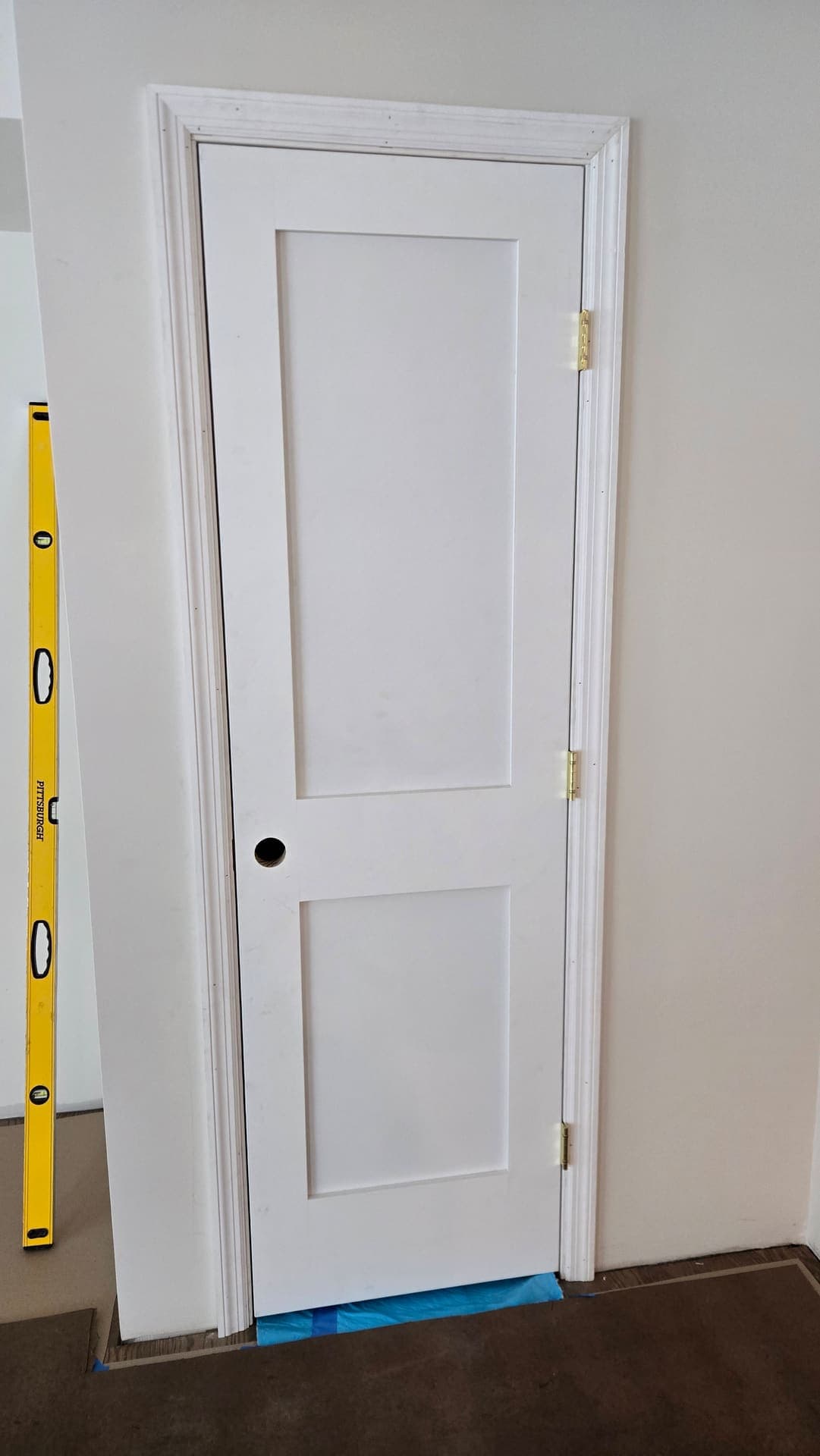
This is why door and window projects in old homes are quietly also lead projects, and why we fold RRP practice into our interior doors and trim work as a matter of routine. A door replacement done under containment removes a lead-bearing friction surface from your house permanently, which makes it one of the rare projects that reduces the hazard while it upgrades the room. Our interior door replacement in West Chester is a representative example: old painted slabs and worn jambs out under plastic, new doors and casing in, dust wiped and verified before the plastic came down.
On price: an interior door installed runs $400 to $650 around here at market rates. Our installs typically land at $350 to $600 per door, containment included, because one crew doing doors all week does not need a learning curve on your job. Nobody has ever framed lead containment as a luxury feature, and we will not start, but it does come standard.
How to vet any contractor on lead, in two minutes
You do not need to become an expert. Three questions sort the field on any pre-1978 project:
- Ask if the firm is EPA RRP certified and for the certification number. A certified firm answers instantly. Verify at the EPA site if you like.
- Ask what the containment plan is for your specific job. You want to hear plastic, tape, wet methods, and HEPA in the answer, described like routine, because for a certified firm it is.
- Ask for the Renovate Right pamphlet. The rule requires the firm to give it to you before work begins. A contractor who has never heard of it has answered your real question.
When you do not need to worry about any of this
The honest closer. If your home was built 1978 or later, none of this applies; the paint on your walls is boring in the best way. If your pre-1978 home has intact, well-adhered paint and no renovation on the calendar, the responsible move is monitoring, not panic: intact paint that nobody is sanding is a stable situation, and repainting over it, encapsulation in plain terms, is a legitimate and inexpensive management strategy, not a cover-up.
And if a small job in your old house falls under the RRP thresholds, a patch, a swapped light fixture, you are allowed to just have it done without ceremony. The rule scales with the dust, and so should your concern. When the project is big enough to matter, hire a certified firm, watch for the plastic and the HEPA vacuum, and then stop worrying, because at that point the system is doing exactly what it was designed to do. That is where we come in: (717) 210-8194, certification number on request.
Questions we hear a lot
How do I know if my house has lead paint?
If it was built before 1978, assume yes until tested; the older the house, the higher the odds and the concentrations, with pre-1950 homes the most likely. Hardware store swab kits around $10 to $30 give quick surface answers, and a licensed lead inspector with an XRF gun can certify the whole house, which permanently exempts it from RRP requirements if it passes.
Is it safe to live in a house with lead paint?
Intact, well-maintained lead paint is a managed condition, not an emergency. The hazard is dust from deterioration, friction surfaces like old windows and doors, and renovation done without containment. Keep paint intact, wet-wipe sills and floors periodically, and use certified practices when work happens, and the risk stays low.
Does the RRP rule apply if I do the renovation myself?
No, homeowner DIY in your own residence is exempt from the rule. The dust is not exempt from physics, though. If you DIY in a pre-1978 home, borrow the professional playbook: plastic containment, wet methods, no power sanding, HEPA cleanup, and keep kids and pregnant family members out of the work area until it is cleaned.