
ADVICE · MAY 6, 2026 · BY DAVID MELNYCHUK
Drywall Over Plaster: Skim It, Overlay It, or Tear It Out?
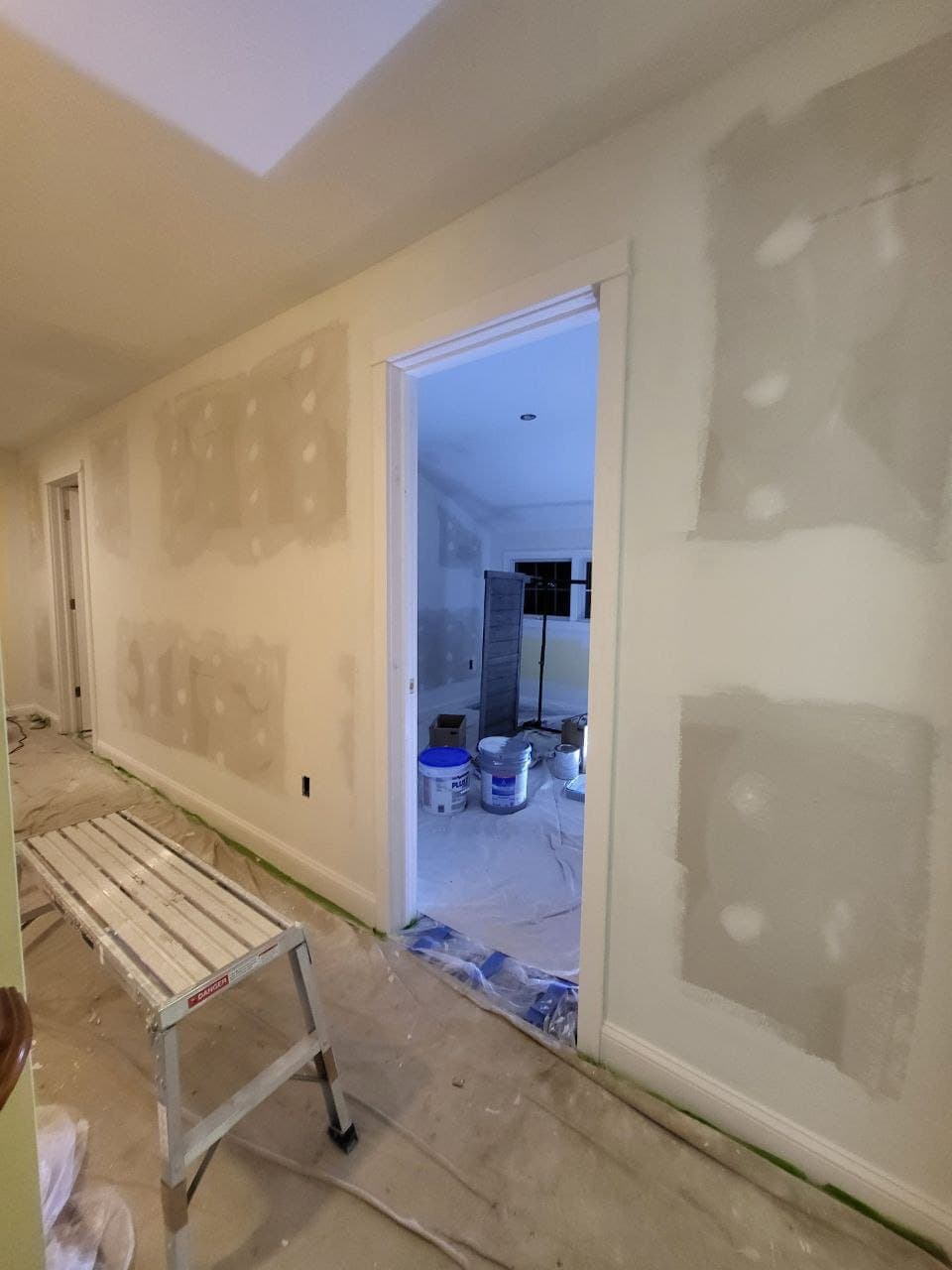
If your house went up before 1950, your walls are plaster over wood lath, and at some point they started cracking, bulging, or shedding chunks behind the couch. Every contractor who looks at them will steer you toward one of three roads: repair what is there, hang new drywall right over it, or rip everything to the studs. Each road is correct for a different wall, and the wrong choice either wastes money or buries a problem.
We work on plaster walls every week across Lancaster and Chester counties. Here is how we actually decide between the three options, what each one costs, and the small details that separate a clean overlay job from one you will be staring at for years.
The three options for old plaster walls
Before anyone talks price, get the vocabulary straight. These are the only three legitimate moves, in rising order of cost and mess:
- Repair and skim coat. Reattach loose sections, fill cracks with setting compound and mesh, then trowel a thin coat over the whole wall for a flat finish. The plaster stays.
- Overlay with drywall. Screw 1/4 inch or 3/8 inch drywall through the plaster into the studs, then tape and finish it like a new wall. The plaster stays buried underneath.
- Full gut. Demolish plaster and lath down to the studs, address whatever is in the wall cavity, hang new 1/2 inch drywall, finish, and repaint.
When repair and a skim coat is enough
If you push on the wall and it feels solid, and the damage is hairline cracks, nail pops, and a few loose spots, the plaster has plenty of life left. Plaster keys, the little hooks of material squeezed between the lath strips, are what hold everything to the wall. When most keys are intact, repair wins. We reattach loose areas with plaster washers or adhesive, bridge cracks with fiberglass mesh, and skim the surface flat.
Around here skim coating runs about $2.00 to $3.25 per square foot when you get quotes from plaster and drywall outfits. Our jobs typically land at $1.50 to $3.00 per square foot, mostly because the same crew that skims also does the repairs, so nobody is billing a second mobilization. A small isolated repair is even simpler: a patch visit runs $250 to $600 and is done in a day.
We wrote a whole decision guide on this in drywall repair or replace if your damage is more scattered than systemic.
When the drywall overlay wins
The overlay is the option most homeowners have never heard of, and it is often the smartest one. We hang 1/4 inch or 3/8 inch drywall directly over the plaster, screwing long drywall screws through the old material into the studs behind it. Then it gets taped, finished, and painted like any new wall.
Why it wins so often: you skip almost all the demolition. Plaster demo is the dirtiest work in remodeling. The dust is fine, it is endless, and it finds its way into rooms you swore you sealed. We have found plaster dust in trucks we did not bring to the job. An overlay produces a fraction of the debris, keeps the lead paint question mostly sealed behind new board on pre-1978 homes, and preserves the mass of the old wall, which is why overlaid rooms stay quieter than gutted ones.
Overlay makes sense when the plaster is too far gone to skim, with widespread cracking or large delaminated areas, but the wall is still basically attached and flat, and you do not need inside the wall cavity. Manufacturer guidance from the Gypsum Association covers laminating new board over existing surfaces, and it is standard practice, not a shortcut.
For cost, figure the same rate as a fresh hang and finish. The going rate in our area is about $2.75 to $4.50 per square foot. Ours typically lands at $2.50 to $4.00 per square foot, plus the trim and extension work below, which is real and should be in any honest quote.
The details people miss on an overlay
Adding 3/8 inch to every wall sounds harmless until you reach anything that penetrates or borders the wall. This is where cheap overlay jobs go wrong, and where you should grill any bidder:
- Electrical boxes. Every outlet and switch box is now recessed too deep, which is a code violation. Each one needs a box extension ring so the device sits flush. Budget a few dollars of material and ten minutes of labor per box, times every box in the room.
- Window and door returns. The jambs are now shy of the new wall plane. Windows need jamb extensions or the returns rebuilt with drywall. Door jambs either get extended with matching stock or the casing sits proud. This is finish carpentry, not drywall work, and it is why our crew doing both matters.
- Trim refit. Baseboard, casing, and crown either come off and go back on over the new surface, or the new board dies into them and looks like it. Pulling 100 year old trim without splitting it takes patience and a flat bar, not a hammer.
- Stair and cabinet lines. Anywhere the wall meets a stair skirt, a countertop backsplash, or built-ins, the extra thickness shows. We plan those terminations before the first sheet goes up.
The honest cases for full demolition
Sometimes the gut is the right call, and we will tell you so even though the overlay is an easier sell. Tear the plaster out when the wall itself is failing: large areas that flex when pressed, plaster raining down inside the wall when you tap it, or bulges that mean the keys have sheared off across whole sections. Screwing new board to a detaching substrate just gives the failure something expensive to hide behind.
You also gut when you need the cavity. If the room needs rewiring, new plumbing runs, or insulation in exterior walls, keeping the plaster means paying an electrician to fish wires blind through balloon framing. Open walls turn that same work into the cheap version of itself. And if there is a history of leaks, mold, or pests, we want eyes on the framing, not hope.
A full gut and re-drywall costs the hang and finish rate plus demolition and disposal, which typically adds $1.00 to $2.00 per square foot depending on access and dumpster logistics. On pre-1978 homes, plaster demo disturbs old paint layers, so lead safe work practices apply and belong in the quote.
What each option costs on a real room
Take a 12 by 12 bedroom with 8 foot ceilings, about 330 square feet of wall after openings. Rounded, honest numbers:
- Repair and skim: roughly $500 to $1,000 if the plaster is fundamentally sound. Fastest and cleanest.
- Overlay: roughly $850 to $1,350 for the board work, plus typically $300 to $700 for box extensions, jamb extensions, and trim refit. Call it $1,200 to $2,000 all in.
- Full gut: roughly $1,200 to $1,900 for demo, disposal, and new drywall, plus whatever you do inside the open walls, which is the point of opening them.
When you should not hire us for this
If your problem is one cracked wall in one room and the rest of the house is fine, you do not need a remodeling contractor and a proposal. A $250 to $600 patch visit handles it, and a capable DIYer with setting-type joint compound and mesh tape can handle a hairline crack for the cost of materials. We would rather tell you that than sell you a skim coat you do not need.
The other case: if you are gutting the room anyway for a larger renovation, do not pay anyone to lovingly restore plaster that is coming down in six months. Sequence matters. Walls last.
How we decide on a walkthrough
We push on every wall, tap for hollow spots, sight down the surface with a flashlight, and check what you actually need from the wall cavity. Then we tell you which of the three roads fits, wall by wall. Often the answer is mixed: skim three walls, overlay the bad one. You can see that exact approach in our plaster restoration in Lititz, where we saved most of the original plaster and replaced only what had failed.
If your plaster has been on your list for a while, our drywall and plaster repair service covers all three options with one crew. Call (717) 210-8194 and we will tell you which one your walls actually need.
Questions we hear a lot
Can you drywall over a plaster ceiling?
Yes, and ceilings are where overlays earn their keep, because failing ceiling plaster is heavy and demolition overhead is miserable. We screw 3/8 inch board through the plaster into the joists, which also mechanically pins any loose plaster in place. Ceiling fixtures need box extensions just like wall outlets.
Does an overlay make my rooms noticeably smaller?
You lose 1/4 to 3/8 inch per wall. In a 12 foot room that is under one percent of the width. Nobody has ever noticed the room. What people notice is sloppy trim and recessed outlets, which is why the finish details matter more than the lost fraction of an inch.
Will I lose the old house character if I cover the plaster?
The character lives in the trim, the doors, the proportions, and the wavy old glass, not in the cracks. We keep and refit the original woodwork over the new surface. If anything, flat quiet walls make the 100 year old casing look better.